GIF basics · 4 min read
What does GIF stand for and where did it come from?
Quick answer
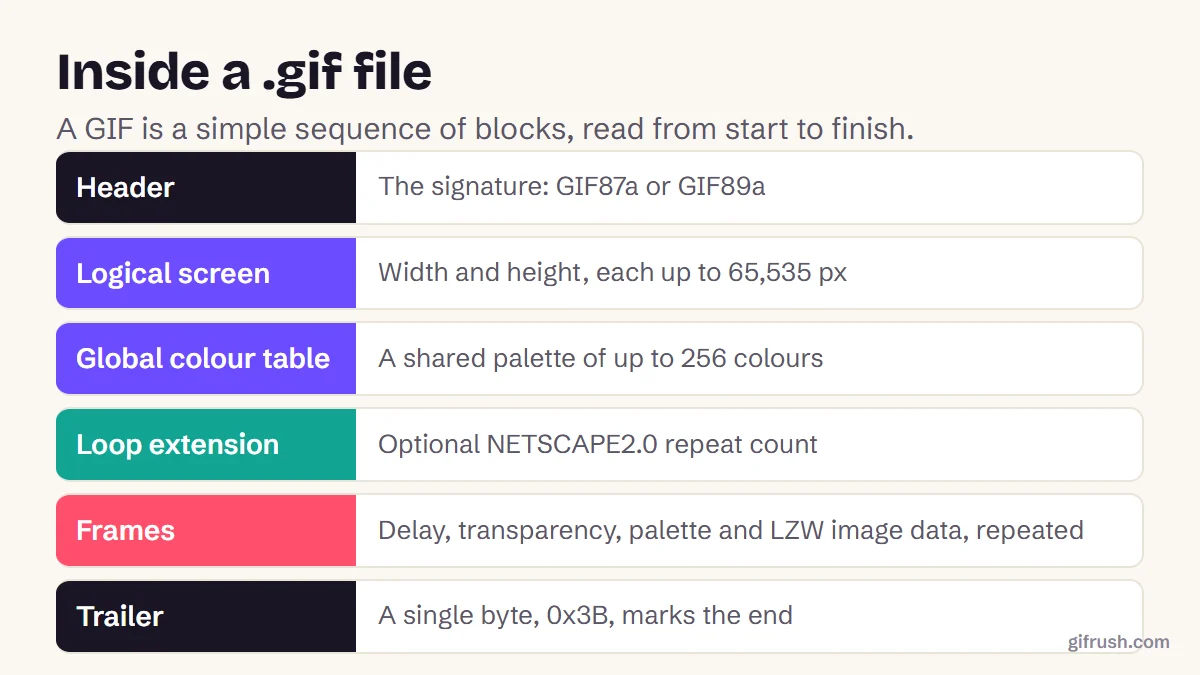
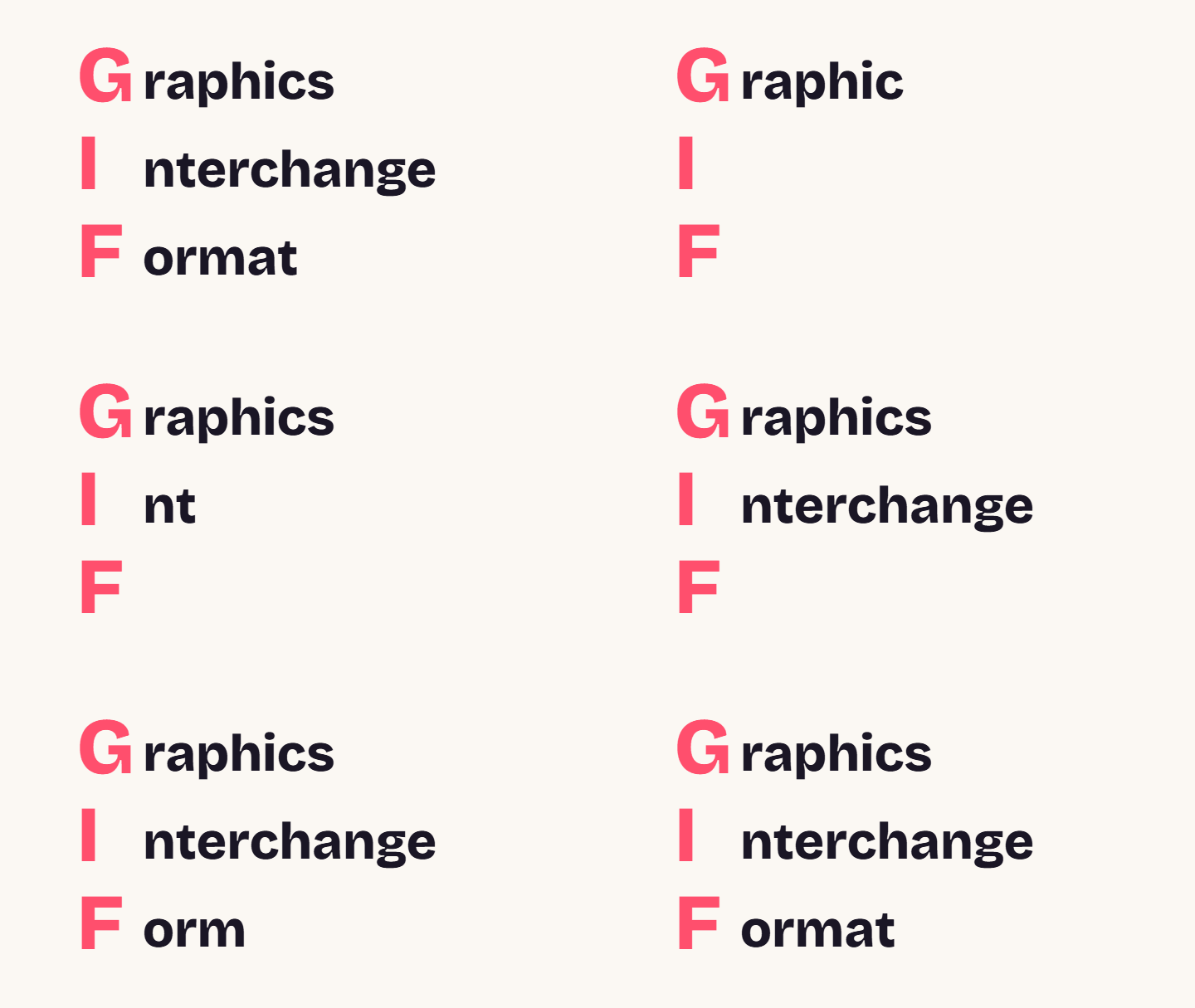
GIF stands for Graphics Interchange Format. It is an image file format that CompuServe released on June 15, 1987, so that pictures could be shared between different computers. A 1989 update added the frame delays that make today’s short, looping animations possible.
Key takeaways
- GIF = Graphics Interchange Format. The “interchange” part was the whole point: one file that any computer could read.
- A CompuServe team led by engineer Steve Wilhite released it in 1987, long before the web existed for most people.
- The format has barely changed since 1989. Its limits, like 256 colours per frame and no sound, are from that era.
- Today “GIF” often just means any short, silent, looping clip, even when the file is secretly a video.
What does GIF stand for?
GIF stands for Graphics Interchange Format. Each word tells you something useful:
- Graphics: it stores pictures, rather than text or sound.
- Interchange: it was designed for exchanging those pictures between different machines.
- Format: it’s a set of rules for how the data is laid out in a file, which is why the name appears as the .gif file extension.
So when someone asks “what does a GIF stand for?”, the literal answer is that name. What people usually mean by a GIF today is the thing the format became famous for: a short animation that loops silently. For the details of how that works, read what a GIF is and how it works.
Why was “interchange” in the name?
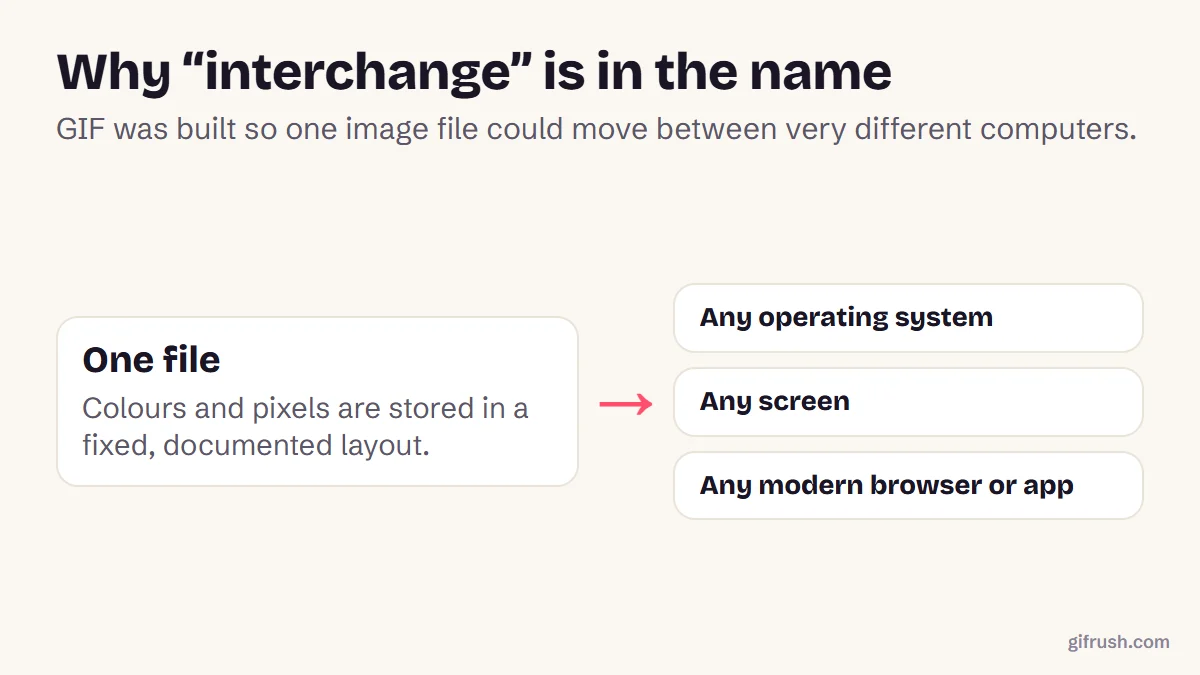
In 1987, computers disagreed about almost everything, including how to store an image. CompuServe, one of the big online services of the time, needed its members to be able to download colour pictures whatever machine they used, over very slow connections.
GIF solved both problems. Its layout was openly documented, and it compressed images with an efficient method called LZW, which made files practical to send over a dial-up modem. According to the format’s history, it replaced CompuServe’s earlier black-and-white format.
A short history of the GIF
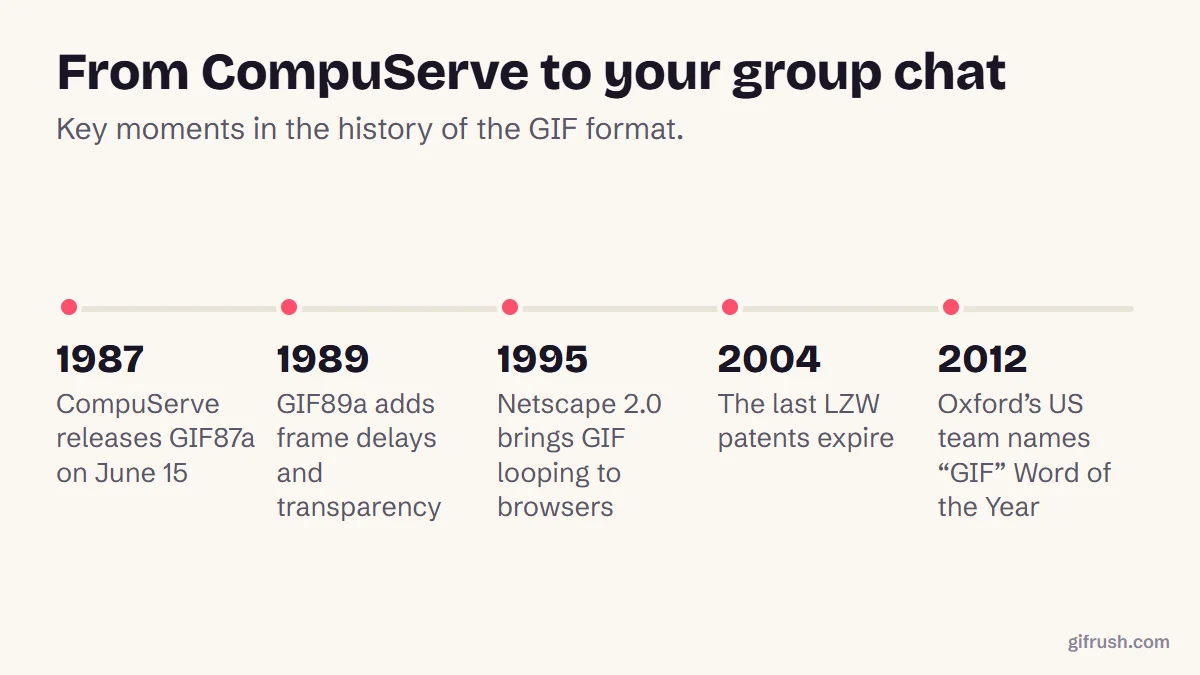
| Year | What happened | Why it mattered |
|---|---|---|
| 1987 | CompuServe releases GIF87a on June 15 | A portable colour image format for online services |
| 1989 | GIF89a adds frame delays and transparency | Animation with timing becomes possible |
| 1995 | Netscape Navigator 2.0 adds looping | The endlessly repeating GIF is born on the web |
| 1995 | PNG is created after a dispute over LZW patent licensing | A patent-free alternative for still images appears |
| 2004 | The last LZW patents expire | GIF becomes free for anyone to use |
| 2012 | “GIF” (as a verb) is the Oxford American Word of the Year | The word enters everyday language |
| 2013 | Steve Wilhite receives a Webby Lifetime Achievement Award | The format’s creator is recognised, and reignites a pronunciation fight |
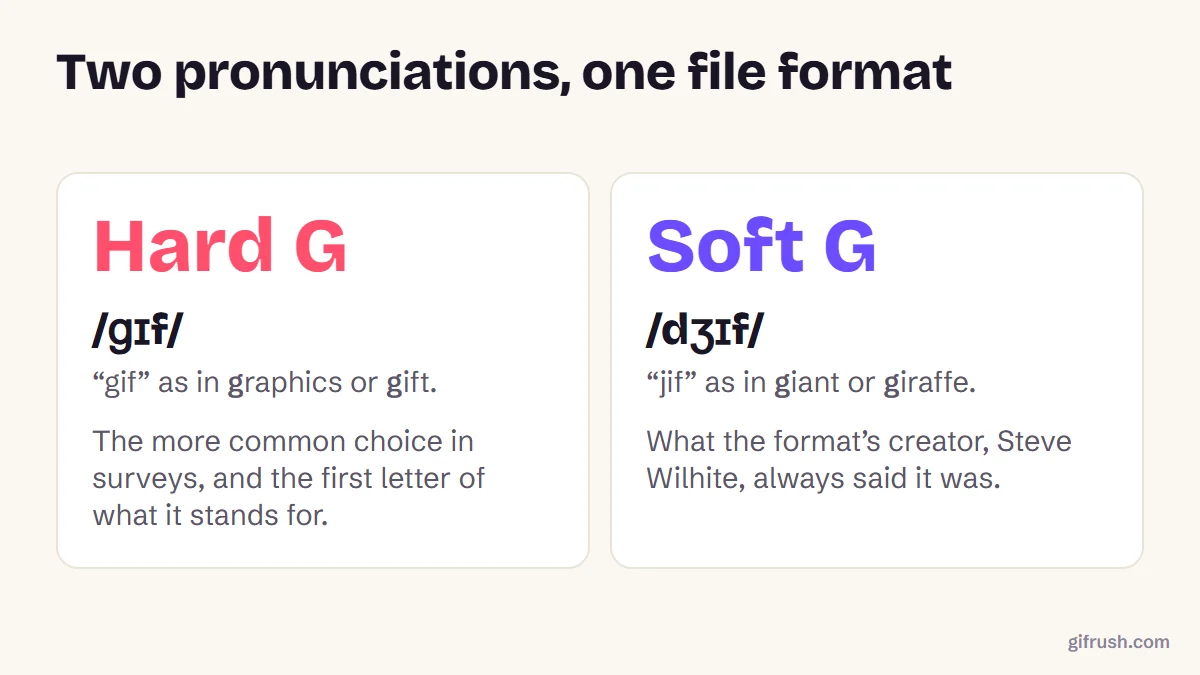
That award speech is why people still argue about the word. Wilhite said the format’s name uses a soft G, and much of the internet disagreed. We cover both sides in how to pronounce GIF. Wilhite died in March 2022 at the age of 74.
Why are GIFs still everywhere?
On paper, GIF should have disappeared decades ago. Modern video is far more efficient: in one web.dev example, the same animation was 3.7 MB as a GIF but 551 KB as an MP4. GIFs survive for reasons that have little to do with compression:
- They just play. No play button, no sound to worry about, no player to load.
- They work almost everywhere, including places where video struggles, such as many email clients.
- They suit how people talk online. A two-second looping reaction says what a sentence can’t, as we explain in what GIF means in a text message.
- They’re easy to make and keep. A GIF is one self-contained file you can save and reuse.
Now you know what it stands for, make one. It’s free, with no sign-up or upload.Open GIF Maker
New to this topic? Start with our main guide: What is a GIF and how does it work?
Frequently asked questions
What does GIF stand for?
GIF stands for Graphics Interchange Format, an image file format released by CompuServe in 1987.
Who invented the GIF?
A team at CompuServe led by engineer Steve Wilhite created the GIF format. It was released on June 15, 1987.
Is GIF an acronym or a word?
It began as an acronym for Graphics Interchange Format, but it now works as an everyday word too. Oxford’s American dictionary team named it Word of the Year in 2012 for its use as a verb, meaning to make a GIF.
What does GIF mean on social media?
On social media, a GIF usually means a short, silent, looping clip, often used as a reaction. Some platforms store these clips as video files but still call them GIFs.
Are GIFs still free to use?
The format is free to use because the last patents on its LZW compression expired in 2004. That doesn’t cover the content of a GIF: a clip from a film or TV show can still be protected by copyright.
Sources
- Graphics Interchange Format, Version 89a (W3C archive of the CompuServe specification)
- GIF (Wikipedia)
- Steve Wilhite (Wikipedia)
- “GIF” beats out “YOLO” as Oxford Dictionary word of 2012 (NPR)
- GIF inventor Stephen Wilhite has died (Engadget)
- Replace animated GIFs with video for faster page loads (web.dev)